UNITED STATES—Vines are very diverse. A few are annuals. A few are perennials. Many are woody vines. Some climb by twining their stems, leaves or tendrils. Some cling onto their support with aerial roots or suction discs. Within home gardens, some need the support of trellises or arbors. Most vines are naturally aggressive, so should get all the support that they need.
Vines that cling onto their supports with roots or suction discs need no trellises or arbors. They climb regardless. English ivy clings with aerial roots. Boston ivy clings with suction discs. Both can be destructive to their support. They ruin paint and promote rot in wood. Therefore, they should only climb surfaces that they cannot damage, such as concrete.
Vines that climb by twining their stems, leaves or tendrils are the sorts that need support. On trellises, some can cover otherwise bare walls or fences, or stand freely like hedges. With arbors, vines frame gateways. On pergolas, they mostly shade patios like small trees. Vines are not low maintenance, though. Actually, they require specialized maintenance.
Trellises, arbors and pergolas only provide support, without limiting growth.
Vines, by nature, seek the top of their support, where they grow the most. Consequently, vines on trellises tend to get top heavy. Carolina jessamine, lilac vine and mandevilla all need grooming to limit upper growth. Then, their lower growth is fuller and more uniform. Star jasmine is naturally more uniform, but even it may get somewhat overgrown on top.
Upper overgrowth may not be so undesirable on arbors or pergolas. However, pruning is as important. Grapevines need annual dormant pruning during winter. Such pruning is a bit more complicated at the height of a pergola. Wisteria can be spectacular on pergolas. It needs aggressive pruning, though, so that it will not become too overgrown and heavy.
Bougainvillea is one of several vines that does not actively climb. It requires guidance to follow trellises or arbors, or to reach the top of pergolas. Then, it needs frequent pruning to avoid overgrowth. Its various cultivars behave differently, though. Some stay compact enough for small trellises and arbors. Some grow large enough for substantial pergolas.
Highlight: Cup Of Gold Vine
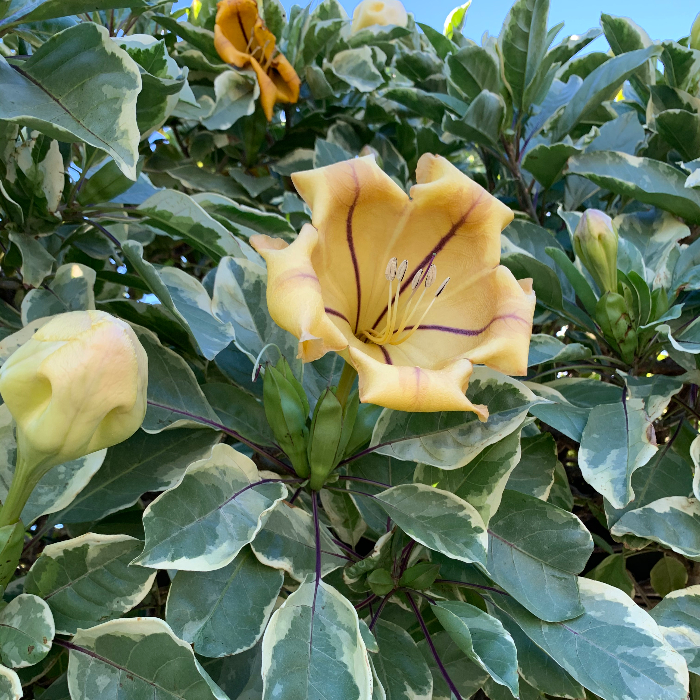
Trellises, arbors and pergolas for this vine should be strong. Cup of gold vine, Solandra maxima, can grow quite large, and it can do so quite fast. It easily reaches forty feet high and wide. Within ideal situations, vines can grow a hundred fifty feet long! Fortunately, it is conducive to frequent pruning. It can grow as free-standing shrubbery without support.
Flowers of cup of gold vine compensate for their lack of abundance with size. Individual flowers may be six to eight inches long and three to six inches wide! Bloom is not overly profuse, though. It occurs mostly between January and May, with a few sporadic flowers during summer. Bloom begins pastel yellow and darkens to richer gold as it progresses.
The simple foliage is nicely glossy. Individual leaves are alternate and two to six inches long. ‘Variegata’ produces delightfully variegated foliage and is relatively docile. Cup of gold vine needs shelter from frost though, so may not be suitable where winters are cool. It grows almost too easily from cuttings or layers. Stems might root where they touch the ground. All parts of it are toxic.
Tony Tomeo can be contacted at tonytomeo.com.