UNITED STATES—The definition of perennial is vague. Technically, it refers to anything that persists for any significant time. This should include trees, shrubbery and vines. Horticulturally, though, it refers to persistent species that lack any woody parts. Even this definition is vague, as it includes ferns, palms, yuccas and succulents. Perennials certainly are a diverse group.
Annuals are not perennials, since they finish their respective life cycles within one year. However, most annuals have potential to perform as perennials. They merely do not get opportunities to do so as other annuals become more seasonal. Biennials complete their life cycles within two years, so also do not qualify. Persistent bulbs might qualify, though.
Canna, for example, grows from thick and fleshy rhizomes that qualify as summer bulbs. Once established they are resiliently persistent. They proliferate and can migrate as they do so. Calla and various ginger do the same. All are easy to propagate by division while more or less dormant. They defoliate where winters are colder, but regenerate for spring.
Perennials are everywhere.
Lily of the Nile is among the most popular and common perennials. It is very resilient and persistent. It does not need much attention or water and is very easy to propagate. Even without bloom, its evergreen foliage is appealing. African iris, or fortnight lily, is probably the second most common perennial. It requires a bit more grooming than lily of the Nile.
New Zealand flax is a bigger perennial, although some cultivars are relatively compact. It is more foliar than floral, since its thin floral stalks are not as striking as its bold foliage. Daylily is among the more floriferous perennials, with bright yellow, orange or red bloom. Beard tongue is another efflorescent perennial, but with white, pink, red or purple bloom.
These are merely a few examples of the most locally popular and practical of perennials. This list should also include hosta, coral bell, yarrow, Shasta daisy and various salvias. It is impossible to mention all of the perennials that perform well here. Although most are evergreen, some are deciduous. Most need irrigation while some can actually naturalize.
Highlight: Canna
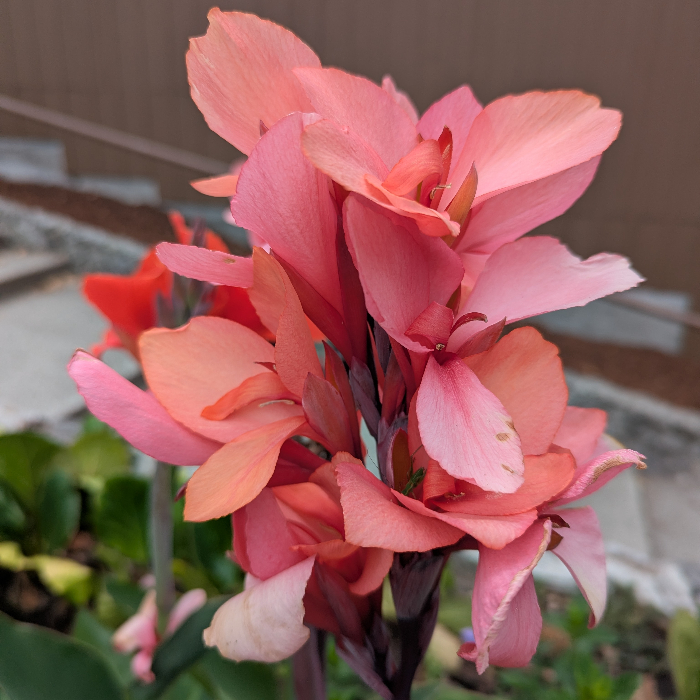
The many distinctive garden varieties of Canna typically begin as late or summer bulbs. They go into the garden as dormant rhizomes at the end of winter or beginning of spring. Then, they grow fast to bloom for summer. They continue to bloom until late autumn or, in mild climates, early winter. However, Canna foliage is as appealing as its colorful bloom.
The big and lush leaves may be green, bronze, striped or variegated. ‘Australia’ has very deep bronze foliage with fiery red bloom. ‘Tropicana’ has green, yellow, bronze and pink stripes with fiery orange bloom. ‘Stuttgart’ blooms merely with wispy pale orange flowers. However, it does so on high stems with foliage which is irregularly variegated with white.
Floral color can be pink, red, orange or yellow, either bright or pastel. Variegated, spotty or blotchy combinations of color are common and popular. Yellowish white is quite rare. Tall Canna can grow eight feet tall, but bloom with small and wispy flowers. Short Canna may stay less than two feet tall, but with big and bold bloom. All growth should be cut back as winter ends.
Tony Tomeo can be contacted at tonytomeo.com.