UNITED STATES—Vegetables and annuals should be growing well with such pleasantly warming weather. Soon enough and into spring, most should be growing like weeds. Unfortunately, though, they are not alone. Undesirable vegetation competes with them for limited resources and space. It is a sadly unavoidable problem, even among the most refined of home gardens.
According to their simplest definition, weeds are undesirable vegetation. Obviously, most of the familiar sorts are annuals or perhaps perennials. However, trees, vines and shrubs can be weeds as well. Silver wattle is an invasive tree which can be difficult to eradicate. English ivy is an invasive vine among many forests. Glossy privet is invasive shrubbery.
With few exceptions, weeds are exotic. In other words, they are not native locally. Native species are generally complaisant within their natural ecosystems. They become weeds only if they become undesirable. For example, native poison oak may grow within home gardens. Native bay trees and some oaks frequently appear where they are undesirable.
Weeds have history.
Most exotic weeds were not always so undesirable. Some were formerly popular for their ornamental qualities and then naturalized. These include pampas grass, yellow flag iris, Hottentot fig and periwinkle. Wild mustard likely naturalized from home gardens where it grew as a vegetable. Many naturalized grassy weeds were originally fodder for livestock.
The smaller but prolific weeds are the most problematic for home gardens. They include dandelion, purslane, burclover, various spurges and various thistles. Of course, there are too many to list. They grow and disperse their seed much more efficiently than desirable vegetation. That is how they invade home gardens and become such a prolific nuisance.
That is also why it is so helpful to remove weeds as soon as possible. Their subsequent generations will be less profuse if they disperse less seed now. Besides, they are easier to pull while only beginning to disperse roots within moist soil. They will be more difficult to pull when more established in drying soil later. Weeding may be tedious, nonetheless.
Highlight: Flowering Apricot
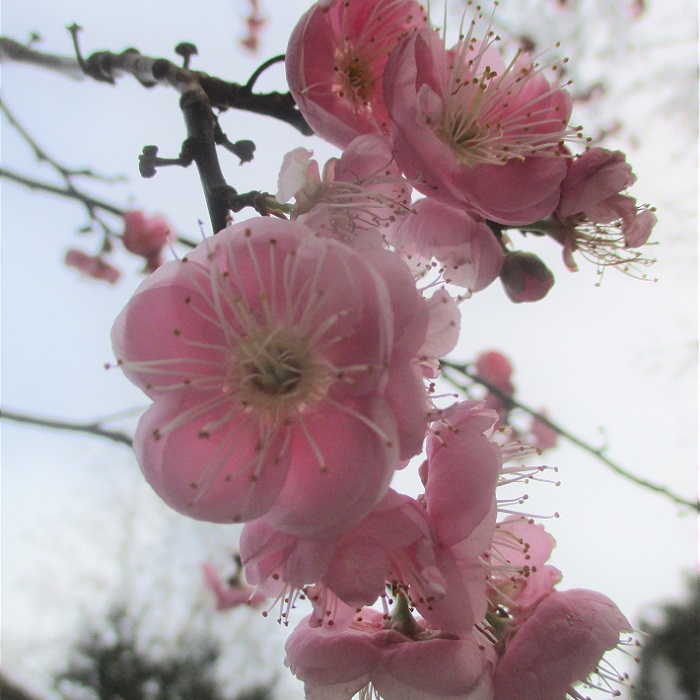
Flowering cherries are not necessarily the first of the flowering trees to bloom. Flowering apricot, Prunus mume, is even earlier than all but the winter flowering cherry. Many have bloomed already, and as early as a month ago. The latest will bloom soon. Their flowers are more resilient to weather than those of flowering cherry. However, they bloom briefly.
Although generally fruitless, a few cultivars produce fruit for pickling, as umeboshi. Such fruit, without pickling, is rather unpalatable. Some cultivars of flowering apricot are useful as understock for related trees. Actually, some local flowering apricot trees grew from the roots of other flowering plums. New trees are very rarely available from nurseries locally.
Mature flowering apricot trees are ten to nearly twenty feet tall and almost as broad. They bloom before they foliate. Abundant bloom on big trees can be mildly fragrant. Individual flowers are about an inch wide. They are pastel pink, but can be white or deep rosy, pink. Blooming stems can be exquisite as cut flowers, although they may not last for very long. Such stems are a traditional component of ikebana.
Tony Tomeo can be contacted at tonytomeo.com.