UNITED STATES—With very few exceptions, all plants have roots. Almost all roots remain out of view within soil or potting media. Consequently, they do not get much consideration or credit for their important functions. They stabilize and collect nutrients for the plants that disperse them. They are as diverse and specialized as the stems and foliage of the plants they sustain.
Naturally, large plants like trees and big shrubbery disperse their roots very extensively. They must in order to obtain the nutrients and moisture they need to sustain themselves. In home gardens, though, they do not need to disperse their roots nearly as extensively. With watering and maybe fertilization, they can obtain what they need relatively closely.
Roots of domestic trees and shrubs are therefore more confined than those of wild trees. They are also closer to the surface of the soil. Roots of plants that prefer better drainage will not disperse very deeply. Unfortunately, some are likely to displace infrastructure on the surface of the soil. They damage sidewalks, curbs, driveways, and even foundations.
Roots disperse where they must.
Repair of such damage typically involves removing or at least severing the causal roots. Severing substantial roots can be stressful to their associated trees or shrubs. It can also destabilize them. Some of such trees and shrubs may actually require complete removal. Future damage is somewhat avoidable by simply planting appropriate trees and shrubs.
Near pavement, appropriate trees should innately exhibit complaisant root systems. For trees that have potential to damage nearby concrete, root barriers might be useful. Root barriers are rigid plastic devices that surround the root systems of new trees. They direct root growth downward. Most extend into the soil two feet deep but are open underneath.
Other types of root barrier are available for established trees. They are either flexible but firm plastic flashing, or fabric studded with herbicide pellets. They too extend into the soil two feet deep. After trenching to cut damaging roots next to pavement, a root barrier goes into the trench. Filling the trench holds the barrier in place to redirect encroaching roots.
Highlight: Crape Myrtle
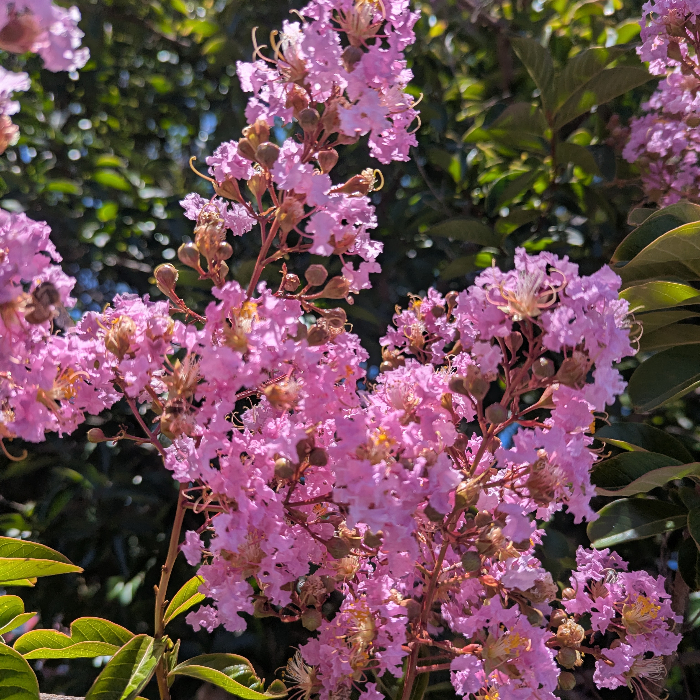
The popularity of crape myrtle, Lagerstroemia indica, is mostly justifiable. It is a compact tree, so is proportionate to small urban gardens. Its roots are very complaisant, so should not displace pavement. It blooms spectacularly for summer and then develops fiery foliar color for autumn. Its only problem is that it is so popular that it has become too common.
The largest cultivars of crape myrtle do not grow much taller than twenty feet. Therefore, they are appropriate for utility easements with high voltage cables. Because of their very docile roots, they are popular as street trees. Although, they do not grow wide enough to provide much shade. Street trees should have single trunks. Others can have multiples.
Floral color is white, pink, red or mauve. Bloom can be very profuse and billowy. Autumn foliar color is bright yellow, orange and red before defoliation. The smooth bark is nicely mottled. Aggressive dormant pruning for winter delays bloom but promotes bigger floral trusses. Crape myrtle enjoys warmth and full sun exposure. It does not need much water, once established.
Tony Tomeo can be contacted at tonytomeo.com.