UNITED STATES—Trees are the most substantial living components of their landscapes. Many grow too big for garden enthusiasts or professional gardeners to maintain them. Such trees will likely eventually require the services of arborists. Arborists are horticulturists who specialize in the horticulture of trees, or arboriculture. Most of the best are certified as such by the ISA.
The ISA is the International Society of Arboriculture. Certification by the ISA first requires arborists to pass an arboricultural proficiency exam. Maintenance of certification requires continuing participation with ISA programs. This includes classes, workshops, seminars and qualified work experience. Arborists must also maintain ISA professional standards.
More information about the ISA is available online at isa-arbor.com. This site includes a link for more consumer information at treesaregood.org. An interactive directory identifies local certified arborists and their tree services. Various articles explain the importance of securing services from qualified arborists. Other resources help select appropriate trees.
Only arborists can compose arborist reports.
ISA certified arborists do more than maintain trees. If necessary, they also remove trees. Many municipalities require permits for removal of significant trees. A permit application requires recommendation for removal from a certified arborist. To prescribe removal, the arborist must compose an arborist report to justify it. Such processes require inspection.
ISA certified arborists do not invariably perform all the procedures that they recommend. Most work with and supervise a few crews who execute their recommended procedures. Arboriculture is very physically demanding work. Some who do it while younger prefer to become consulting arborists when a bit older. Their work experience is a valuable asset.
The need for arboriculture becomes more apparent at particular times of the year. Winter storms make it more obvious. Also, several trees prefer pruning during winter dormancy. However, various arboricultural procedures are seasonable at various times of the year. Most of such procedures can be performed whenever convenient, at any time of the year.
Highlight: Japanese Black Pine
Most pines grow too large for compact urban home gardens. Japanese black pine, Pinus thunbergii, is an exception. Although it can grow bigger in the wild, it does not get much taller than 20 feet here. It takes many years to grow as broad, typically with irregular and sculptural form. Because of its form, it is quite conducive to pruning for confinement.
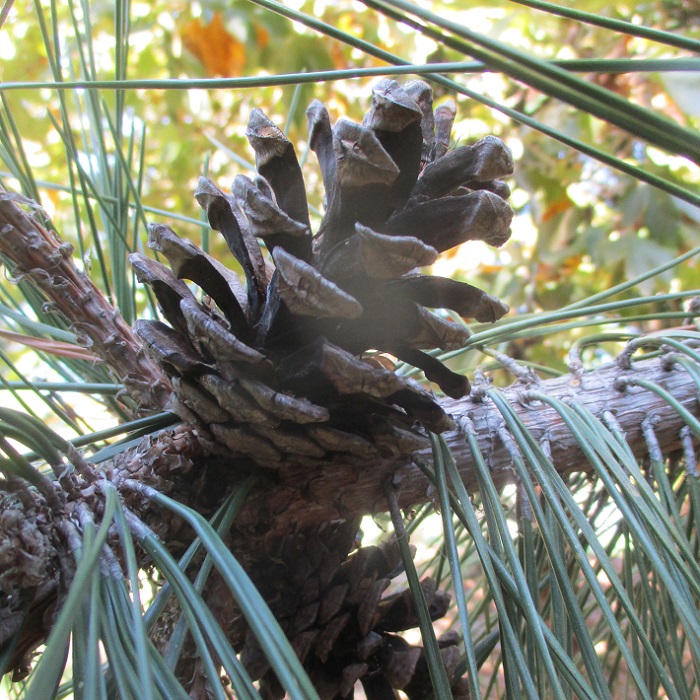
The evergreen foliage of Japanese black pine is rich deep green. Its paired needles are about four and a half inches long, and somewhat stiff. Its stout cones are only about two or three inches long. They are as green as their foliage while developing but eventually become brown. Even young trees have handsomely flaky bark, which darkens with rain.
Japanese black pine is notably undemanding. It supposedly prefers slightly sandy soils that drain efficiently. However, it performs well within local soils. Disease and pathogens are quite rare here, although boring beetles sometimes appear. Japanese black pine can thrive in large pots if pruned to be proportionate. It is popular for both bonsai and niwaki, and can perform for centuries.
Tony Tomeo can be contacted at tonytomeo.com.