UNITED STATES—Weeds are plants that grow wildly where they are undesirable. Therefore, all weeds are plants, but not all plants are weeds. Similarly, dirt is soil or similar substances where it is undesirable. Therefore, some dirt is soil, but soil is not necessarily dirt. The assumption that soil is dirt is disrespectful to the foundation of the garden. Roots know the difference.
Roots are experts in regard to soil because they inhabit it. They must disperse through it to procure nutrients and water, and to conduct respiration. They also provide stability for their associated stems and foliage above. Various soils are naturally diverse. Vegetation is more diverse to exploit them. Not many soils can not sustain some type of vegetation.
Soil, most simply, is the loose aggregates on the surfaces of most land. Loose is relative, since some soils are dense and quite hard. The inorganic aggregates range in size from microscopic clay particles to coarse sand. Most soils include small stones. Some include significant stones. Almost all soils contain organic material. Exposed bedrock lacks soil.
Soil texture can limit what performs well within it.
The texture of a soil is its ratio of the three basic components, sand, silt and clay. Sandy soils drain efficiently, but do not retain moisture as well as dense clay soils do. Clay soils retain more moisture, but do not drain as efficiently. Like climates, soils limit what grows well in a garden. Although local soils are of good quality, some benefit from amendment.
Soil amendments, such as compost, may improve both drainage and moisture retention. They also improve aeration and, as they decompose, they generate additional nutrients. Such organic amendments are helpful with the installation of new plants. They promote healthy dispersion of roots. They are also particularly useful for annuals and vegetables.
Fertilizers promote growth by providing more of the nutrients that the soil provides. Each nutrient promotes different types of growth. For example, phosphorus promotes floral and fruit growth. Nitrogen promotes vegetative growth. The formulation of synthetic fertilizers is very precise for specific results. Organic fertilizers can be less potent, but are effective.
Highlight: Fraser’s Photinia
Old fashioned photinias, which are now rare, are thorny and messy with copious berries. Almost all modern photinia, though, are Fraser’s photinia, Photinia X fraseri. It is a hybrid that is both thornless and fruitless. It is also among the most popular plants for evergreen hedges and screens. Therefore, it is readily available from nurseries and garden centers.
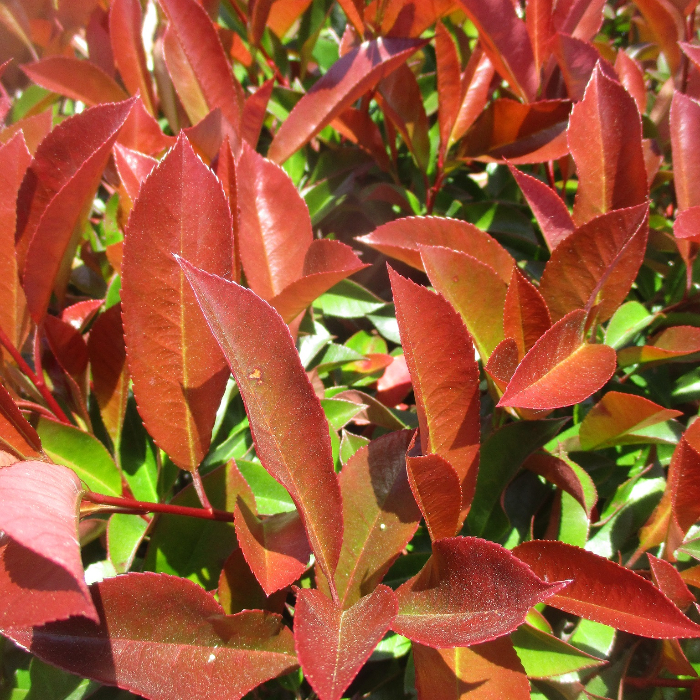
After shearing, Fraser’s photinia develops richly reddish bronze new foliage. Such color eventually fades to dark green. However, the process repeats after each shearing, which may be three times annually. Shearing also enhances foliar density, and refines hedges. Bronze color is best in spring, after late winter shearing. It fades slightly faster in summer.
Without shearing, Fraser’s photinia can become a small tree as tall as fifteen feet. Foliar color is less vivid, though, and only develops once for spring. Also, unshorn trees bloom, often profusely, with big trusses of tiny white flowers. Some find the floral fragrance to be objectionable. Compact or variegated cultivars of photinia may sometimes be available.
Tony Tomeo can be contacted at tonytomeo.com.