UNITED STATES—Many flowers are fragrant. Many are colorful. Several are both. The majority, though, are neither. That is because flowers use fragrance and color only to attract pollinators. Most flowers rely on wind for pollination, so do not need to attract pollinators. Such flowers are not so conspicuous, though. Fragrance and color are much more prominent and popular.
Most prominently colorful flowers are not very fragrant. They do not need to be. Flowers can use one technique or the other, fragrance or color, to attract pollinators. They do not need to waste resources on redundancy. Hibiscus, dahlia, sunflower, daisy, camellia and canna all lack floral fragrance. Yet, they efficiently attract pollinators with their floral color.
Most prominently fragrant flowers are similarly not very colorful. Night blooming jasmine, sweet box and sweet osmanthus produce small white flowers. Yet, they efficiently attract pollinators with their floral fragrance. Gardenia is more colorful only because its blooms are larger. Star jasmine is more colorful only because its blooms are much more profuse.
Floral color can be redundant to floral fragrance.
Victorian box and mock orange also bloom with fragrant but subdued flowers about now. Most angel’s trumpet blooms with fragrant but impressively large flowers in pastel colors. Hyacinth, narcissus, freesia and lily flowered both fragrantly and colorfully last spring. So did wisteria and pink jasmine. Daphne flowers are diminutive but fragrant for next winter.
Modern roses and some bearded iris are not as fragrant as some old cultivars. Many lack fragrance altogether. This is generally because fragrance had not been a priority of their breeding. Both roses and bearded iris now bloom with bolder flowers, which last longer. Roses bloom for a longer season, instead of only once. Fragrance was the compromise.
Floral fragrances are as diverse as the pollinators that they attract. This is because, like floral color, they appeal to particular pollinators. A few appeal to a single specific species of pollinator. Several flowers disperse their fragrance at night for nocturnal moths or bats. Most flowers, though, are receptive to pollinators that they do not intentionally appeal to.
Highlight: Night Blooming Jasmine
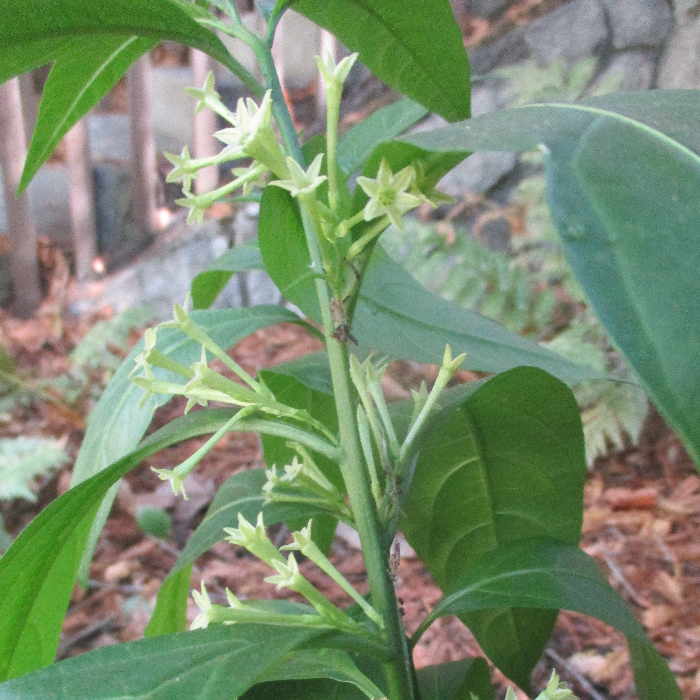
Looks can be deceiving. Night blooming jasmine, Cestrum nocturnum, does not look like much. It looks even less interesting in the darkness of night. However, its floral fragrance on warm summer nights is famously sugary and intense. Some might find it too intense. Nocturnal moths and bats are its preferred pollinators, so it is not fragrant during the day.
Because of its mundane appearance, night blooming jasmine is good in the background. It tolerates a bit of partial shade, so can be happy close to fences and buildings. It works well witin narrow spaces between houses and below high windows. Where winters are cool, it needs shelter from frost. It appreciates somewhat regular watering and rich soils.
Mature night blooming jasmine rarely grows higher than first floor eaves. It is quite easy to maintain lower, particularly if pruned aggressively after winter. Its narrow floral trusses suspend several small and narrowly tubular flowers. Individual flowers are about an inch long, and greenish white or pale yellow. Simple evergreen leaves are a few inches long, and narrow.
Tony Tomeo can be contacted at tonytomeo.com.