UNITED STATES—Why are more urban shade trees not fruit trees? Urban landscapes could produce much more food than they already do. It could be so nice to be able to pick fresh fruit from trees in parks or flanking streets. After all, this region formerly sustained orchards of fruit trees. It could certainly sustain more fruit trees again. Why waste space on mere shade trees?
Many cities in California sustain more trees than they naturally did prior to urbanization. Both San Jose and Los Angeles were chaparral grassland with only isolated woodlands. Their urban trees are now more numerous than native trees were only two centuries ago. The same applies to several urban areas, including San Diego, Bakersfield and Fresno.
Trees are not only more abundant than they naturally were. They are also more practical. They perform specific functions. Those that are street trees must develop high canopies and need minimal maintenance. Those in parks must be broad enough to create shade. For many reasons, fruit trees are impractical for such applications in public landscapes.
Fruit trees are not low maintenance.
Fruit trees generally require significantly more maintenance than typical shade trees do. Deciduous fruit trees require specialized dormant pruning each winter. Without adequate pruning, their limbs become overburdened with fruit and break. Such pruning is very time consuming. It also necessitates cordoning off space below trees during the procedures.
Also, fruit trees are significantly lower than shade trees. This facilitates both specialized pruning, as well as collection of fruit. Street trees and most shade trees are much higher for clearance below. With the same clearance, particularly over roadways, fruit would be out of reach. Limbs that are low enough to produce fruit within reach would be obtrusive.
Fruit that is out of reach becomes messy below. For street trees, it becomes a slip hazard on paved surfaces. Furthermore, fruit attracts unwanted wildlife, including rats, raccoons and opossums. Ultimately, trees selection should be appropriate to specific applications. Fruit trees are better within private home gardens. Shade trees should not produce fruit.
Highlight: Grape
Grape, Vitis spp., has been in cultivation for approximately eight thousand years! That is a very long time for many diverse varieties to develop. Most are cultivars of Vitis vinifera, but other species and hybrids are in cultivation also. Grapes are useful for juice, vinegar, wine, jelly, fresh eating and dried as raisins. Each application utilizes particular cultivars.
Grapevines are very vigorous. Without pruning, some can climb more than 50 feet high. Within home gardens, specialized dormant pruning limits most to less than 10 feet high. On larger vines, fruit is awkward to reach. Vines climb with tendrils, but are conducive to redirection on trellises, fences or arbors. They are deciduous, so are bare through winter.
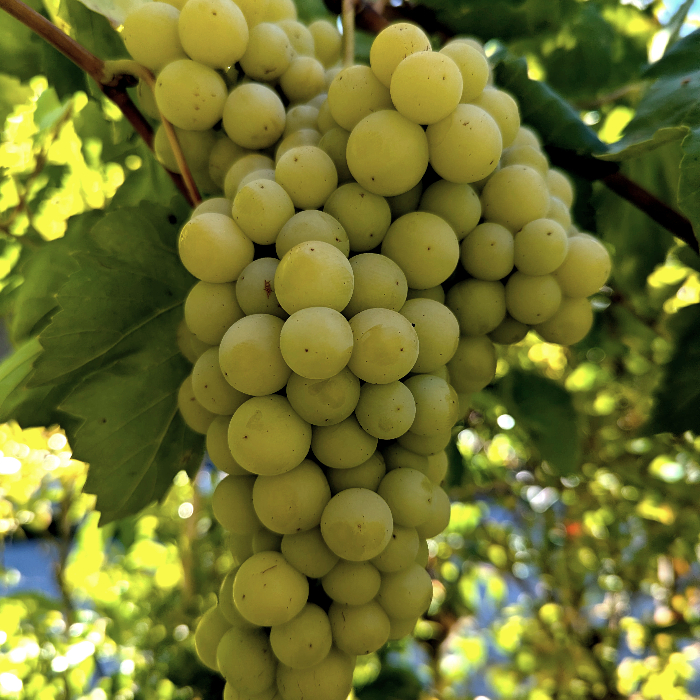
Grapes grow in clusters of all sizes, from only a few grapes to two hundred or more. Fruit can be green, yellow, orange, red, pink, purple, dark blue or black. Table grapes are the most familiar seedless type for fresh eating. Wine grapes are smaller and contain seeds. Established vines do not need much water. Excessive irrigation can compromise flavor. Bare root vines become available for winter.
Tony Tomeo can be contacted at tonytomeo.com.