
UNITED STATES—Culinary herbs are mostly aromatic foliage. Their respective flavors are generally similar to their distinct aromas. Parsley, sage, rosemary and thyme are a few popular examples. So are basil, cilantro, chive, mint, oregano, dill, lavender and bay leaf. Ironically though, herbal flavors and aromas repel some insects or grazing animals. Such is their purpose.
The aromatic foliage of rosemary, for example, is a popular culinary herb. However, such foliage is aromatic primarily to repel grazing animals. So, it is both repulsive to deer and coincidentally appealing for culinary application. Its endeavor to be unpopular has made it popular. For organisms that lack olfactory perceptions, plants make productive use of it.
Rosemary, though, is also popular because it is useful for landscape application. Some trailing cultivars grow as ground cover. Others are shrubby. Various species and cultivars of lavender are similarly useful for landscape situations. Bronze fennel became popular more for its visual appeal than its aromatic foliage. Many herbs can perform double duty.
Aromatic foliage is not all herbal.
Also, several plants that are not herbs have exceptionally aromatic foliage. Both trailing and shrubby lantana are almost obnoxiously aromatic. Society garlic, breath of Heaven, rockrose and some salvias can be also. While aromatic foliage should be appealing, it is sometimes objectionable to some. Warmth and humidity typically enhance foliar aroma.
Some aromatic foliage only exudes its aroma when disturbed. Junipers can be aromatic during their pruning but may not be otherwise. Incense cedar, camphor and the various eucalypti and conifers are very aromatic. However, their foliage is very often out of reach. Native bay trees are very big, but culinary Grecian Bay is proportionate to home gardens.
Because of aromatic foliage, window boxes became popular in ancient European towns. They were convenient planter boxes for growing herbs where garden space was scarce. Also, they sustained aromatic foliage that repelled mosquitoes prior to window screens. Trailing rosemary, nasturtium and ivy geranium are still very traditional accompaniments.
Highlight: Lion’s Tail
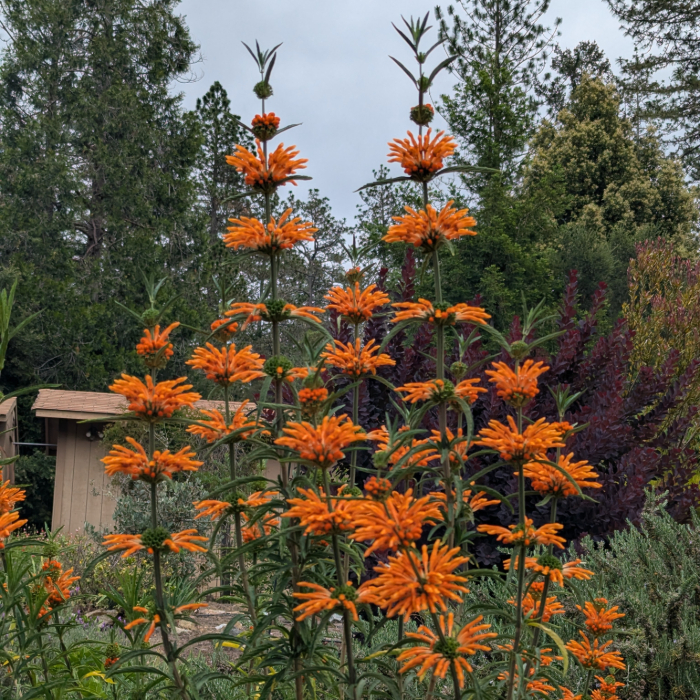
Too much bloom should be no problem. Although, for lion’s tail, Leonotis leonurus, it can be. It blooms for the middle of spring. Then, it continues blooming in increasingly prolific phases until late summer or autumn. There is little time for deadheading between bloom phases. Furthermore, deadheading too aggressively delays subsequent bloom phases.
It is best to prune deteriorating bloomed stems just below their lowest floral tufts. Pruned stems can then generate side shoots that should bloom for a subsequent phase. Growth unfortunately gets congested by the end of the season. Coppicing late in winter removes all of such congested growth. This promotes new growth and a new beginning for spring.
Mature specimens can grow taller than six feet by the end of summer, and slightly wider. Their narrow leaves are about three inches long. They bloom with dense tufts of tubular flowers in neat tiers on the upright stems. Floral color is almost exclusively bright orange. Cultivars with yellow or white bloom are rare and not as bright. Foliage is very aromatic. New plants are easy to propagate by division while plants are coppiced.
Tony Tomeo can be contacted at tonytomeo.com.


