UNITED STATES—Warm season annuals may not seem ready to relinquish their space. Although some are beginning to get tired after a season of performance, some are not. They might be happy to continue blooming until cooler winter weather. Bedding plants are temporary, though. The time for winter annuals, or cool season annuals, to have their turn is now beginning.
There is no rush, though. Only cool season annuals that begin as seed must do so while the weather is still warm. Most begin as cell pack seedlings, so can, if necessary, wait for a little while longer. Some actually prefer to begin later in autumn. Ornamental kales and cyclamens can wait until winter. Various cool season annuals are on various schedules.
Besides, various warm season annuals are also on various schedules. Some deteriorate sooner than others. Ideally, their replacement should coincide with the beginning of their deterioration. Some are already deteriorating, so are ready for their replacement. Others, though, can perform until cooler autumn weather. Their replacement is generally sooner.
Some cool season annuals are actually perennials.
Some annuals, both warm season and cool season, are actually perennial. They merely perform as annuals because replacement is easier than salvage. They likely get shabby during their off season but can have potential to survive. Wax begonias, for example are warm season annuals. They get tired through winter but can survive until the next spring.
On small scales, cool season annuals can coexist with overwintering wax begonias. For example, pansies can partially obscure tired wax begonias through winter. In spring, the wax begonias may regenerate to replace the pansies. Sweet Williams and primroses are cool season annuals that are actually perennials. They can survive through the summer.
Pansies and violas are the most familiar and reliable of cool season annuals. Marigolds, calendulas, and snapdragons are popular autumn annuals. Cyclamens and ornamental kales can replace them later for winter. Stocks are notably fragrant cool season annuals. Alyssums can begin about now and continue into next summer, as if they are perennials. Iceland poppies are nice for pots and smaller plantings. Cornflowers are nice wildflowers for cutting.
Highlight: French Marigolds
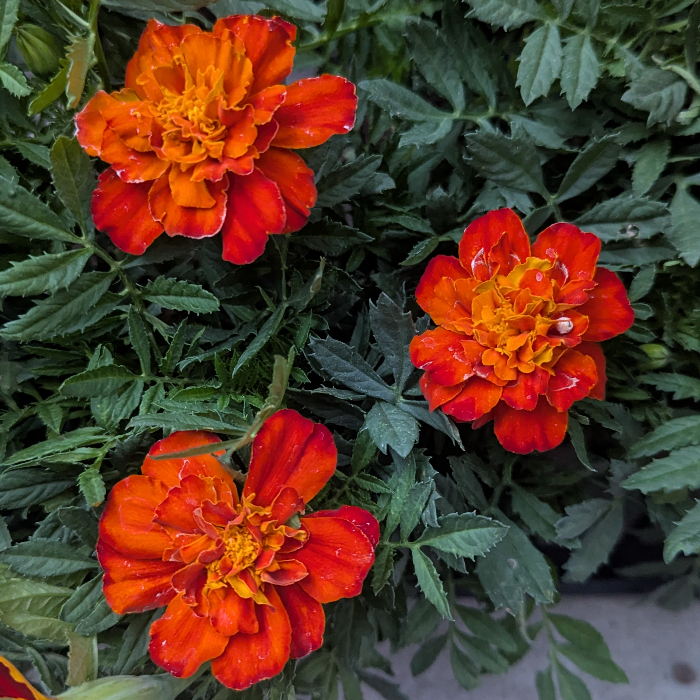
The Maya actually cultivated marigolds long before the French. The ancestors of French marigolds, Tagetes patula, were native to Mexico and Guatemala. French horticulturists merely hybridized the varieties that are now most popular. The largest varieties can grow a foot high and broad. Most, though, stay significantly lower as compact bedding plants.
Contrary to their popularity during autumn, French marigolds are warm season annuals. With frequent deadheading, they can perform from spring until cool winter weather. They are popular as short-term annuals merely because they perform best while young. Bloom is slightly less abundant as they age. They can perform as well for spring as for autumn.
Many varieties of French marigolds are available. Yet, their floral color range is limited to yellow, orange and red. Brown flowers are really dark orange. Creamy white flowers are really very pale yellow. White marigolds are uncommon because richer colors are more popular. Like most bedding plants, French marigolds want rich soil and regular watering.
Tony Tomeo can be contacted at tonytomeo.com.