UNITED STATES—Berries such as firethorn might be the most colorful features of some home gardens now. Flowers can be scarce for late autumn and winter. Yet, people still enjoy decorating their homes with vegetation from their gardens. Cut evergreen foliage actually becomes more popular than cut flowers had been. It is a basic component of traditional Christmas decor.
Christmas trees are the most extreme form of cut evergreen foliage. With few exceptions, though, they do not grow within home gardens. Instead, they grow on farms and become available for sale before Christmas. Availability from such sources is remarkably diverse. Not many home gardens have adequate space for cut Christmas tree cultivation anyway.
Wreaths and garlands are the second most extreme forms of cut evergreen foliage. Many are available for sale like cut Christmas trees are. However, many people create wreaths and garlands from what inhabits their gardens. After all, wreaths and garlands are merely stylized floral design which lack containers. Most, but not all, lack anything floral as well.
Wreaths and garlands are stylized floral design.
Because wreaths and garlands lack containers, their components must not wilt too soon. The best evergreen foliage is coniferous. However, some broadleaf foliage works nicely. Even defoliated deciduous twigs can be intriguing. Pinecones can substitute for flowers. There are not many rules to floral design, or for the composition of wreaths and garlands.
Collection of evergreen foliage for wreaths and garlands should not disrupt a landscape. Ideally, such foliage should be in need of removal anyway. For example, stems that need pruning can provide significant material. Pruning cuts from source material must be done properly, without stubs or disfigurement. The many rules of responsible gardening apply.
Fir, spruce, pine and cedar are some of the better evergreen foliage for Christmas decor. They are uncommon, though, within local home gardens. Italian cypress, arborvitae and juniper are more common. Boxwood, various hollies and various pittosporums are some broadleaf alternatives. Southern magnolia and New Zealand flax may add bold contrast. So do coral bark Japanese maple twigs or tufts of ornamental grass.
Highlight: Mugo Pine
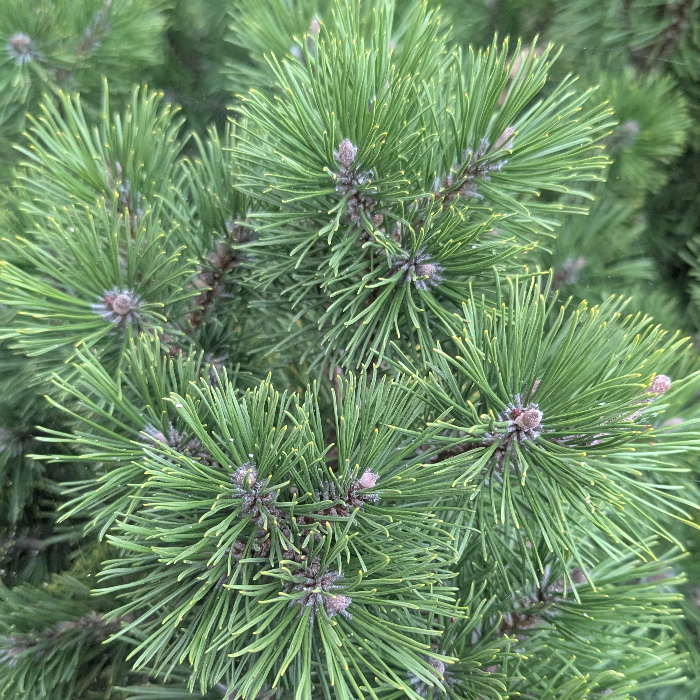
Although it classifies as a tree, mugo pine, Pinus mugo, is more like shrubbery. Old trees may be only a few feet tall, and maybe twice as wide. Not many are more than eight feet tall. Their form is densely rounded. Foliage is deep forest green. Stiff paired needles are only about one to two inches long. Plump cones are not much longer and are quite rare.
Mugo pine, although native to the Alps, is a traditional feature of Japanese gardens. Yet, it is rare within other types of gardens. It does not grow fast or big enough to be practical for much more than aesthetic appeal. It does excel at that, though, by developing such a distinctly rounded form. Mugo pine can work well as foundation planting or a short informal hedge.
Mugo pine is not particularly discriminating about local soils or climates. It merely craves sunny and warm exposure. Mature specimens do not need much water but are healthier with occasional irrigation. Mugo pine appreciates room for unrestricted growth. Shearing deprives it of its natural form and texture. If necessary, selective pruning may be tedious.
Tony Tomeo can be contacted at tonytomeo.com.