UNITED STATES—Almost every plant needs sunlight. Only parasitic plants that lack chlorophyll are the few exceptions. Even they rely on plants that need sunlight to conduct photosynthesis. Some plants require full sun exposure, while others tolerate some degree of shade. Actually, a few plants prefer partial shade. Situating plants accordingly promotes their performance.
Modern home gardens are generally shadier than older home gardens. They are smaller and surrounded by larger homes and fences. Taller fences, taller hedges and evergreen trees obscure adjacent homes. They also produce more shade. Plants that tolerate some degree of shading have consequently become more popular. They require less sunlight.
Most of such plants are understory plants. In their natural habitats, they live in the partial shade of larger plants and trees. They should do the same within home gardens. Ferns, philodendrons, alocasias, colocasias and Natal lily are a few examples. They are some of the few plants that actually prefer partial shade. They can roast with too much sunlight.
Sunlight is a limiting factor.
Azaleas, rhododendrons, andromedas and hydrangeas are also understory plants. They prefer a bit more sunlight than the other examples, though. They like eastern exposures, where they get plenty of sunlight, but only in the morning. Then, they are in partial shade as the weather gets warmer after noon. However, some can tolerate more sun exposure.
Oleander, bougainvillea, lavender, lily of the Nile and agaves are the opposite. They like full sun exposure as well as warmth. Unshaded southern and western exposures are no problem for them. Shade inhibits their performance and promotes thin etiolated growth. Most yuccas and cacti require sunlight and warmth but can be difficult to accommodate.
Northern exposures are the shadiest. Southern exposures are the sunniest and warmest. Both eastern and western exposures are partly shady, but eastern exposures are cooler. They get all their sunlight prior to noon, while western exposures get all theirs after noon. Big eaves extend shade. Deciduous trees shade during summer, but not through winter.
Highlight: Hydrangea
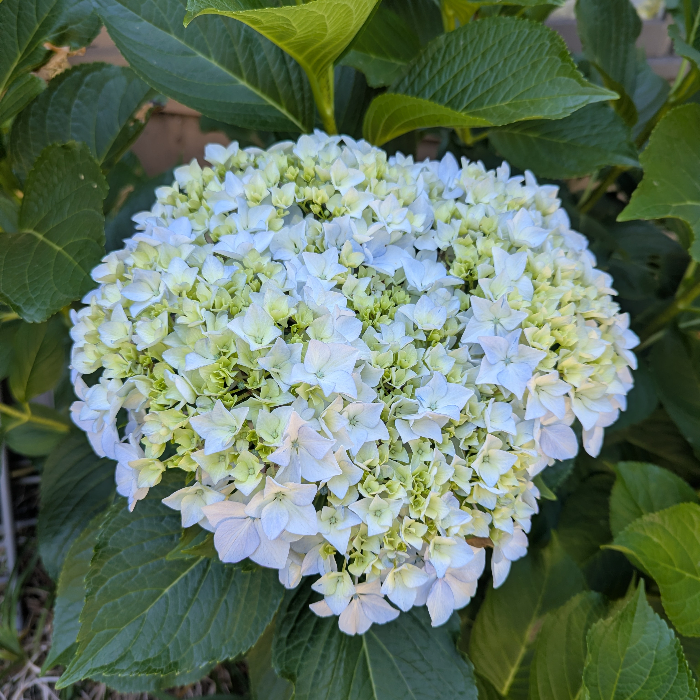
Old fashioned hydrangea, Hydrangea macrophylla, were somewhat predictable. Those that developed color bloomed pink in alkaline soil or blue in acidic soil. White hydrangea only bloomed white. Nowadays, some cultivars bloom better in pink while others bloom better in blue. Pink cultivars in acidic soil or blue cultivars in alkaline soil may be purple.
Floral form has also evolved significantly. Old fashioned hydrangeas bloom with big and rounded trusses of many small flowers. Such trusses are about four to eight inches wide. Some modern cultivars bloom with flatter or conical trusses. Some produce tiny florets in the center with bigger florets around them. All hydrangeas bloom for summer or autumn.
Big hydrangeas can grow about six feet high and wide. Most modern cultivars are more compact. The deciduous foliage is lush. Individual leaves are about six inches long, with serrate edges. Hydrangeas perform better after dormant pruning during winter, to remove older canes. Younger canes that grew during the previous season will be more vigorous.
Although bulky, hydrangea blooms are delightful as cut flowers. All parts of hydrangea, though, are toxic.
Tony Tomeo can be contacted at tonytomeo.com.