UNITED STATES—Trees and utilities should not mix. Unfortunately, on rare occasion, they do. Trees cause electrical outages or fires by dropping limbs onto electrical cables. Telecommunications are also susceptible to such disruption. Arborists maintain clearance for utility cables, but can not eliminate all hazards. Several trees are simply too large and too close to utilities.
Of course, this is more of a problem within rural areas, where native trees grow wild. It is also sometimes a problem within urban areas, though. Many urban trees are too large for their particular situations. Some extend their growth within easements for aerial utilities. Selection of trees that are proportionate to their situations helps to avoid such problems.
Any palm tree that can grow tall enough to reach utility cables should avoid them. Palms grow only upward, so are not conducive to pruning around such cables. Any that get too close to high voltage cables will be subject to decapitation. That entails removal of their solitary terminal buds, which kills them. Then, their dead carcasses necessitate removal.
Utilities have precedence over trees.
This is unfortunately a common problem. Mexican fan palms commonly grow below high voltage cables. This is because birds that drop their seed so often perch on such cables. Also, queen palms are popular for planting within rear corners of backyards. This is often directly below aerial utilities. Queen palms reach such utilities within only several years.
Palm trees are not the only concern in regard to utilities. Various sycamores, ashes and elms vigorously grow quite tall. Canary Island pine and sweetgum develop upright form. Actually, any tree that grows as high as high voltage cables should avoid them. Plenty of smaller trees are available. Clearance pruning for aerial utilities is potentially disfiguring.
Pruning any tree near high voltage cables is extremely hazardous. This is why electrical service providers employ professionally trained arborists to do so. Unfortunately, though, proper arboricultural technique is not a priority. Safety and reliability of electrical service are. Pruning for clearance of utilities is efficient but can severely damage subject trees.
Highlight: Mexican Fan Palm
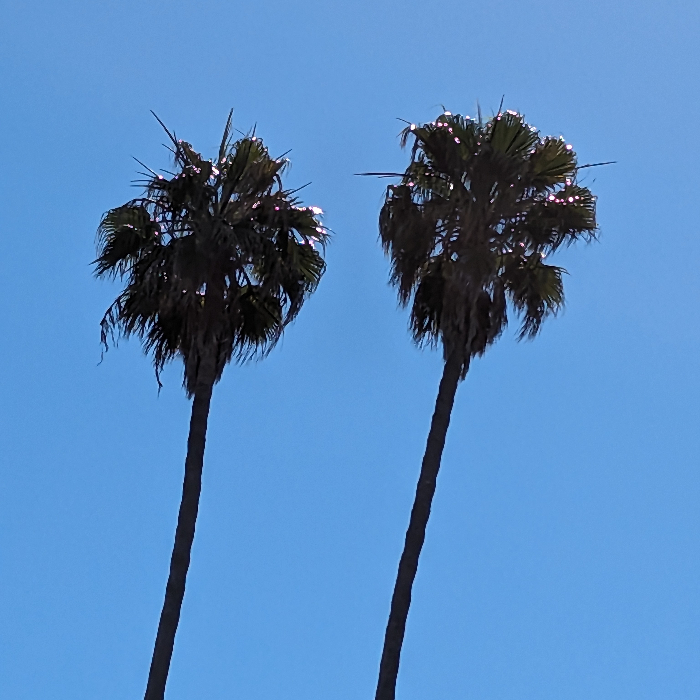
Queen palm might now be the most popular and common palm here. However, Mexican fan palm, Washingtonia robusta, is still the most prominent. That is because it is so very tall! It grows quickly to about fifty feet tall. Growth decelerates with maturity; but old trees are about twice as tall. Some of the tallest local specimens are more than a century old.
Mexican fan palms are about twice as tall as California fan palms, but slimmer. Their tall trunks lean as prevailing winds blow them. Consequently, some of the tallest lean above adjacent gardens rather than their own. The pleated and palmate leaves are about three feet broad. They are about six feet long with their petioles, which have unpleasant teeth.
Mexican fan palm is not discriminating about soil or water. It commonly self-sows where it gets no irrigation and grows well without it. With irrigation, it only grows faster. Without pruning, Mexican fan palm accumulates beards of dry fronds. With pruning, it can either retain a lattice of petiole bases on its trunk or be shaven. Only arborists can prune them properly.
Tony Tomeo can be contacted at tonytomeo.com.