UNITED STATES—So much summer fruit is now in season. Most cherries have finished, but apricots, plums and prunes are still ripening. Nectarines and peaches will ripen immediately after them. Almonds will be the earliest nuts to ripen later in August or so. Birds, squirrels and other wildlife are eagerly watching and waiting. If they have not stolen fruit yet, they likely will.
Fruit appeals to wildlife like flowers do. Flowers employ attractive colors and fragrances to appeal to wildlife that pollinates them. Many reward such pollinators, which are mostly insects and hummingbirds, with nectar. Similarly, fruit uses attractive colors and aromas to lure wildlife that disperses its seed. Such fruit is compensation for this important work.
It is therefore only natural for wildlife to damage or abscond with fruit from home gardens. Such wildlife includes squirrels or various birds, or perhaps rats, opossums or raccoons. Protecting ripening fruit from them can be daunting. For some situations, it may not even be possible. Typically, wildlife takes only some fruit. However, sometimes, it ruins all of it.
Wildlife is elusive.
Protection of fruit requires some familiarity with whomever exploits it. Squirrels and birds are visible as they are active during the day. Opossums, raccoons and rats are nocturnal, so are not visible during the day. Opossums and rats tend to nibble fruit but leave it on its stems. Raccoons tend to take fruit off trees to eat on the ground, leaving bits and pieces.
Bird netting can exclude birds, but is difficult to install, and almost impossible to remove. If effective for the particular birds, flash tape is an easier and more practical option. Fake owls or snakes deter both birds and squirrels. Relocation every few days improves their credibility. Because they are unfamiliar, plush toys may be as effective to deter squirrels.
Tree trunk baffles can protect fruit from opossums and raccoons. However, they are only effective if there is no other access from adjacent trees or fences. Rosemary, lavender or mint around fruit trees can supposedly be a minor deterrent. Not much deters a raccoon, though, once fruit starts to ripen. Electric fencing can be effective but is not so practical.
Highlight: Prune
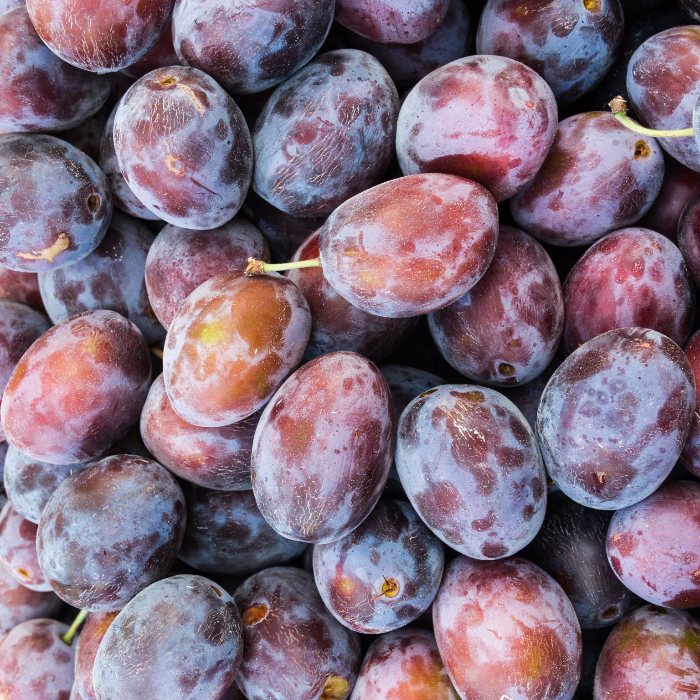
A prune is not merely a dried plum. Plums and prunes are really two distinct types of fruit. Plums are Japanese cling fruits, with their ripe flesh firmly adhered to their pits. They are rounder, softer, juicier, more colorful and best for fresh eating. Prunes, Prunus domestica, are European freestone fruits. They are slightly oblong, firmer, sweeter and dark purple.
Because of their higher sugar content, prunes are more popular dried than fresh. Plums are likely to mold during the drying process because they contain less sugar. Prunes are also better for canning and juicing than plums. However, for marketing purposes, modern prunes now qualify as plums. Plum juice is apparently more appealing than prune juice.
Regardless of their differences, plums and prunes are of the same genus. They grow on similar trees that require the same dormant pruning through winter. Dwarf trees are about ten feet tall. Semi-dwarf trees, which are the most popular, can get almost fifteen feet tall. Efficient pruning keeps them shorter so that more of their fruit grows within reach.
Tony Tomeo can be contacted at tonytomeo.com.